Researching a British Army ancestor can be frustrating. In many cases, all that survives is a service number, a regiment name mentioned in a family story, or a faded photograph with little information attached. Without a surviving service record, it can be difficult to know where to begin.
The British Army Service Explorer was created to help bridge that gap. Using a combination of archival records, published research, service number studies, and military sources, the tool can help identify likely regiments, battalions, enlistment periods, recruitment areas, and theatres of war from a British Army service number or unit designation.
The tool contains four separate search pathways, covering both the First and Second World Wars. Whether you are starting with a service number and trying to identify a unit, or already know the battalion or regiment and want to learn more about its wartime service, there is a search option designed to help.
This guide provides a step-by-step walkthrough of each search type, explains how to interpret the results, and offers suggestions for what to do next in your research journey.
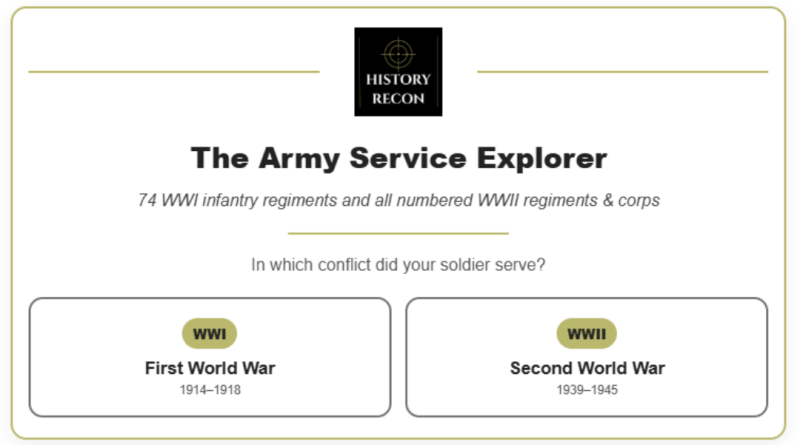
Step 1: Select the Conflict
The Army Service Explorer begins by asking a simple question: "In which conflict did your soldier serve?" This first step ensures that you are directed to the correct set of research tools and databases.
The First and Second World Wars used very different numbering systems. During the First World War, service numbers were generally issued by individual regiments, meaning the same number could potentially appear in multiple units across the Army. By contrast, the post-1920 numbering system used during the Second World War allocated blocks of numbers to specific regiments and corps, allowing for a different approach to identification.
Selecting the correct conflict is therefore an important first step. If you are unsure, clues such as medal groups, service dates, family photographs or surviving documents may help determine which option to choose.
Once you have selected either WWI or WWII, the Explorer will present the available search options for that conflict.
To find out more about the WWI regiments we cover view our Technical Hub here.
To find out about other WWII Corps and regiments in the tool, check our Technical Hub here.
Step 2: Choose Your Search Method
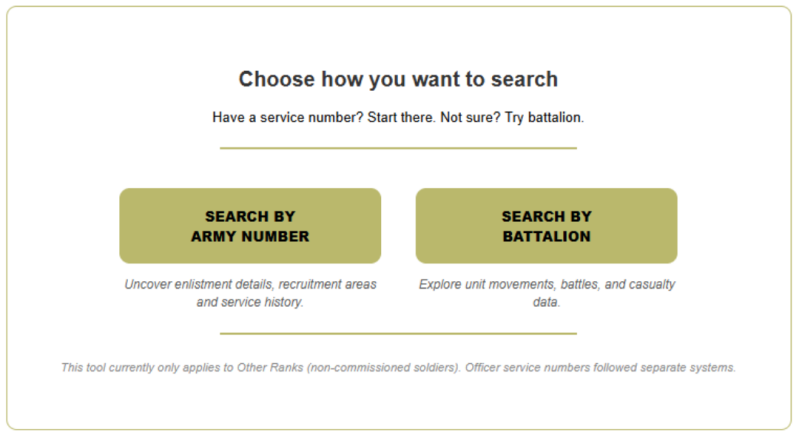
Once you have selected either the First or Second World War, the Explorer presents two different ways to begin your research.
The first option is to search using an Army Service Number. This is usually the best starting point if you have found a service number on a medal, service record, casualty record, headstone, photograph, or family document. The Explorer will use this information to identify likely units and provide additional clues about a soldier's military service.
The second option allows you to search by Battalion (WWI) or Regiment/Corps (WWII). This pathway is designed for researchers who already know the unit in which their ancestor served and want to learn more about its movements, campaigns, battles, and wartime history.
In simple terms:
* Have a service number? Start with an Army Number Search.
* Know the unit but not the service number? Choose Battalion Search (WWI) or Regiment/Corps Search (WWII).
The Army Number Search is generally the most popular option, as many surviving military records and family heirlooms include a service number even when little else is known about the soldier's service.
WWI Service Number Search Results
Once a service number has been entered, the Explorer generates a detailed summary designed to help researchers understand both the soldier and the unit they may have served with.
The first section displays the most likely battalion match, alongside any alternative possibilities. In some cases, multiple battalions shared the same enlistment block, meaning it is not always possible to identify a single battalion with complete certainty. Where this occurs, the Explorer clearly explains the ambiguity rather than presenting a potentially misleading result.
The Confidence Rating provides an indication of how precise the estimate is likely to be. Factors such as the 1917 Territorial Force renumbering scheme, wartime casualties, administrative transfers, and gaps in surviving records can all affect the accuracy of service number analysis. A broad confidence rating does not necessarily mean the result is incorrect; rather, it indicates that multiple interpretations remain possible.
The results page also explains the identified Battalion Type. This helps researchers understand whether the soldier most likely served in a Regular, Territorial Force, Service, Reserve, or other category of battalion. Where relevant, additional historical context is provided to explain terms and enlistment conditions that may be unfamiliar to modern readers.
To help place the soldier within a wider geographical context, the Explorer highlights likely Recruitment Hotspots associated with the identified battalion or regiment. These locations often represent key recruiting areas and can provide useful clues when researching family origins and local military connections.
The Probable Enlistment Period attempts to place the soldier within the wider timeline of the war. For example, an early enlistment may suggest pre-war Regular service or participation in the opening campaigns of 1914, while later enlistments may indicate service in one of the New Army formations raised during the conflict.
The Explorer also highlights a battalion's Signature Engagements, allowing researchers to see some of the major battles and operations associated with the unit. This provides valuable context and helps transform a service number into a more complete wartime story.
Finally, the results include a summary of the regiment's Casualty Toll during the First World War. While these figures do not represent the experience of an individual soldier, they help illustrate the scale of sacrifice made by the unit and provide additional context for understanding its wartime service.
WWI Battalion Search Results
While the WWI Service Number Search focuses on identifying a soldier's likely battalion, the WWI Battalion Search is designed to help researchers understand the battalion itself.
The results begin by placing the unit in its historical context. The Outbreak of WWI section shows where the battalion was stationed when Britain entered the war in August 1914. For many researchers, this provides a useful starting point for understanding where a unit began its wartime journey.
The Explorer also explains the battalion's classification. Whether the unit was a Regular, Territorial Force, Service, Reserve, or another type of formation, the accompanying notes explain how that battalion was raised, recruited, and employed during the conflict. This helps researchers unfamiliar with British Army terminology understand the role the unit played within the wider war effort.
To provide geographical context, the results highlight likely Recruitment Hotspots associated with the battalion. These locations often reflect the areas from which the unit drew its recruits and can help connect a battalion to the communities it represented.
For researchers attempting to assess whether a service number may belong to a particular battalion, the Explorer also includes Possible Enlistment Number Ranges where reliable evidence exists. These ranges are intended as a guide rather than definitive proof, as wartime transfers, casualties, reinforcements, and administrative changes often resulted in overlapping number blocks between battalions.
The Signature Battles section highlights some of the major engagements associated with the unit. From Mons and Loos to the Somme and Passchendaele, these battle summaries help place a battalion within the wider story of the war and provide a useful starting point for further research.
Finally, the results include a Regimental Casualty Toll, illustrating the scale of sacrifice endured by the regiment during the conflict. While these figures do not represent the experience of a single battalion or soldier, they provide important context and help demonstrate the human cost of the First World War.
WWII Service Number Search Results
The WWII Service Number Search is designed to help identify a soldier's likely regiment or corps using their Army service number. Unlike the First World War, where service numbers were often unique only within individual regiments, the post-1920 numbering system allocated blocks of numbers to specific regiments and corps across the Army. This allows a service number to provide valuable clues even when little else is known about a soldier's service.
The first section of the results identifies the most likely Regiment or Corps associated with the number. Where relevant, the Explorer also provides explanatory notes to help researchers understand how infantry regiments, armoured units, artillery formations, and other branches of the Army were organised during the war.
The results then highlight likely Recruitment Hotspots. While recruitment became less geographically focused than during the First World War, many regiments still retained strong links with particular counties and regions. These locations provide useful historical context and may help connect a soldier to local recruiting traditions.
The Recruitment Phase indicator estimates when the soldier most likely entered military service. Depending on the number range, the Explorer may suggest a pre-war Regular or Territorial Army enlistment, an early-war volunteer, a mid-war conscript, or a later wartime intake. This helps place a soldier within the wider timeline of Britain's wartime mobilisation.
The Explorer also provides an overview of the regiment's likely Theatres of Service. These maps highlight some of the major areas in which the regiment or corps served during the war, allowing researchers to quickly visualise the global nature of British military operations between 1939 and 1945.
The Campaign Medals section introduces the principal campaign stars and medals associated with the regiment's wartime service. While this does not guarantee that an individual soldier qualified for every medal shown, it provides a useful guide to the awards most commonly associated with service in those theatres.
Finally, the results include a Regimental Casualty Toll, helping place the regiment's wartime experience into context. These figures illustrate the scale of losses suffered during the conflict and provide a reminder of the sacrifices made by the regiment and its soldiers throughout the Second World War.
WWII Regiment and Corps Search Results
The WWII Regiment and Corps Search is designed for researchers who already know the soldier's unit but want to understand its role, organisation, and wartime service in greater detail.
Unlike the Service Number Search, which works from an individual's Army number, this pathway begins with the regiment or corps itself. It is particularly useful when family records, service documents, photographs, or medal groups have already revealed the unit in which a soldier served.
The results begin by displaying the regiment or corps alongside its associated Army Number Allocation Range. These ranges were used by the Army to allocate service numbers to particular regiments and corps and help explain why the Service Number Search is often able to identify a likely unit from a number alone.
The Explorer also provides contextual notes explaining the nature of the organisation being viewed. For example, infantry regiments, artillery formations, armoured units, and specialist corps all fulfilled very different roles within the British Army. These explanations help researchers understand how a particular unit fitted into the wider military structure.
The Recruitment Hotspots section highlights the traditional recruiting areas associated with the regiment or corps. While recruitment became increasingly national in scope during the Second World War, many units retained strong regional identities and historical connections with particular counties, cities, or communities.
The Campaign Medals section introduces the principal campaign stars and awards associated with service in that regiment or corps. These medals provide useful context for understanding where the unit served and the types of operations it undertook during the war.
The Explorer also summarises the unit's likely Theatres of Service. Some regiments served primarily in one theatre, while others operated across multiple fronts throughout the conflict. Where a unit's service was truly global, the results explain that no single theatre can be reliably inferred from regiment-level data alone.
Finally, the results include a Regimental Casualty Toll, providing an indication of the losses suffered during the war. These figures help place the regiment's wartime experience into perspective and offer a reminder of the scale of sacrifice endured by British Army units between 1939 and 1945.
Next Steps in Your Research
The British Army Service Explorer is designed to provide a starting point for military research, helping to transform a service number or unit designation into meaningful historical clues. While the tool can often identify likely battalions, regiments, enlistment periods, recruitment areas, and theatres of service, it should be viewed as the beginning of the research journey rather than the final destination.
Once you have identified a likely unit, there are several avenues worth exploring. Surviving service records, medal rolls, casualty records, war diaries, regimental histories, and local newspaper archives can all help build a more detailed picture of a soldier's military career. Even when a full service record has not survived, combining information from multiple sources can often reveal where a soldier served and the experiences they may have shared with their unit.
The Explorer is continually being expanded and refined as additional regiments, number studies, and historical sources become available. As a result, some searches may provide highly precise results, while others may offer broader estimates based on the surviving evidence.
Every service number represents a real person who volunteered, enlisted, or was called upon to serve. Behind each number lies a unique story of service, sacrifice, and experience. Whether you are researching a family member, exploring local history, or investigating a medal group, the British Army Service Explorer aims to make those stories a little easier to uncover.
If you would like assistance taking your research further, History Recon also offers a range of professional research services, from record verification and medal entitlement checks to full military service reconstructions. These can help bridge the gap between a service number and the wider story of an individual's military career.
We hope the British Army Service Explorer helps you take the next step in discovering your soldier's story.
Ready to Begin?
Use our free military research tool to identify likely battalions, regiments, enlistment periods, recruitment areas, theatres of service, and campaign information from British Army service numbers.